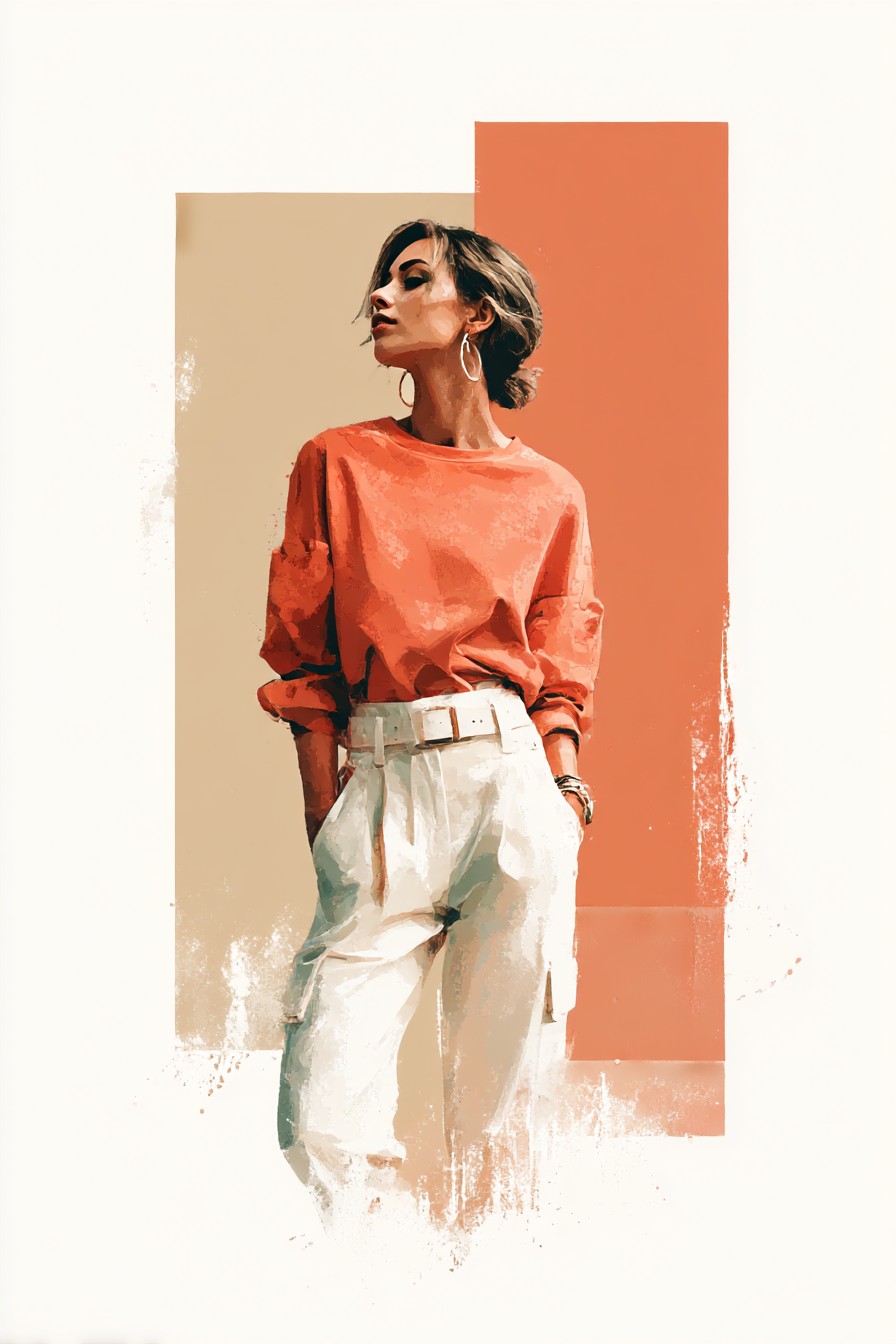
Allow me to preface this story with my deeply ingrained skepticism of any fashion formula described as “foolproof.” Between 27 years of life and 15 years of working in fashion, I’ve learned that dressing well is hardly a perfect science. So when my assistant Mia burst into our Monday team meeting arguing I had to see the new TikTok formula that was “literally changing people’s lives,” I fought back laughter with eye-rolls. “It’s not just another stupid formula, I swear!” Mia pleaded between frantic scroll-stops. “Look at these comments, people are saying it changed their life. SAME, my brother; who wore the same Black Keys t- shirt for five days straight last week; says it ‘kinda works.” She paused, expecting me to be swayed by a testimonial from a 23-year-old boy who wore literally the same thing every day until I adopted him.
Clearly, it was life-changing. My inner journalist (and OK, my slow content week) took over from there. Within minutes I was down a TikTok rabbit hole of creators and civilians claiming that a simple four-step formula was the secret to consistently dressing well.
The formula itself ; Base + Interest + Completer + Accessories = Outfit; wasn’t anything fancy. It looked like something my kindergarten taught me to solve math problems.

But videos explaining it have amassed over 800 million views; thousands more people have tried it out for themselves and posted duets explaining why they “can’t live without it.” Below is one of the most popular examples: “If you followed these four steps, you would literally always match,” says user @lexisclothing.
The comments are littered with people who’ve tried it themselves: “I used to be terrible at putting outfits together but this formula has helped me so much,” wrote one user. “This is literally how I’ve always dressed 100% unintentionally.
Now that I know there’s a formula I can do it with pride,” said another. “This isn’t baby calculus,” I whispered sarcastically to Mia as we watched the 18th personatee boast about how they used four simple steps to throw together a “10/10” outfit. But the audience was clearly into it.
So was I, begrudgingly. When something blows up on TikTok with quite the range of people ; teen girls and off-brand Hilary Clintons alike ; you can bet we’ll all take it seriously here at SCO. Which brings me to: Why?
I called up an actual mathematician to understand why something so simple went viral. Here’s what mathematician and accidental fashion guru Dr. Elena Rodriguez had to say. “When you boil it down, ‘Outfit formula’ isn’t really a formula mathematically,” said Dr.
Rodriguez. applied mathematics professor at NYU who literally wrote the book on fractals. “It’s really just an algorithm; defined steps that can be followed repeatedly to achieve a desired outcome. I love it because it leaves enough wiggle room for you to be creative, but gives you just enough structure to help you avoid decision paralysis.” Translation: It’s like training wheels for your wardrobe. But apparently good ones.
Here’s how “Outfit Math” breaks down: Pick something you want to wear that leans more on the boring side to be your Base. That means your trousers, skirt, dress, or shorts paired with a top. You can literally start with a t-shirt and jeans if you want.
The key is starting with well-fitting pieces that you know look good on you, no matter how basic. Choose something to layer over your base that you wouldn’t describe as boring. “Interest” can be a chunky jumper, graphic tee, coloured trousers, etc. The key is that it adds visual interest to your outfit.
Creators note this doesn’t have to be wild or trendy; a simple texture, unexpected colour, or subtle pattern will do the trick. Now grab something to completely (see what I did there?) overlay your base and interest piece. The majority of TikTokers claim this is the “completer” piece most people forget when they feel like something is missing in an outfit.
Jackets, cardigans, vests, and overshirts are common completer pieces. Layer on some accessories! Scarves, jewellery, hats, bags, shoes ; whatever you got.
The only rule is that they should accentuate your outfit and draw attention to your interest piece, not distract from it. The reason I loved this formula over other “how to dress well” hacks I’ve read is that it actually prescribed manageable steps instead of vague rules. Most of us have heard style advice that instructs us to “add a pop of colour” or “accessorize wisely,” but those aren’t concrete enough guidelines for the average person to implement.
Outfit Math breaks the process down into straightforward steps that novices can follow while still leaving room for personal style. “It made me realise that I wasn’t finishing my outfits,” said Marc, 34, graphic designer and longtime wearer of jeans and t-shirts who began using the formula after his sister showed it to him. “I would wear a shirt and jean combo that I knew looked good on me, but then I’d skip the jacket and grab whatever shoes were closest. Once I started adding a jacket as my completer piece and thinking through my accessories instead of wearing whatever, my outfits actually looked put together wearing the same style of clothes.” Marc’s story was commonplace. Everyone I spoke with for this story said they weren’t necessarily changing the items they owned or loved wearing; they were learning how to better use them and ensure that each piece they put on fell into a specific category. “I actually had all the pieces I needed to wear to feel like I crushed the meeting,” said Taylor, a 42-year-old consultant and mother of two. “I just wasn’t thinking about how I was combining them.
Now I make sure to pick a base, completer, and accessory, even if that means skipping my favourite jumper.” For me, the most interesting discovery was seeing how widely the formula seems to be impacting people of all ages, sizes, genders, and style aesthetics. Whether you’re into vintage wardrobe thrift-shopping or buying everything off your IG’s feed, there’s an example of someone who looks just like you rocking outfit math. “Weekday workwear for the win!” writes one plus-size TikTok creator. “Outfit math for my fave body type- the rectangle!” says another. “This works for any style,” says creator Kyra, who has made the formula the cornerstone of her over 2 million followers on TikTok. “So whether you’re big into streetwear, or love feminine pieces; gown dressing or power suits; you can use this formula to customise it to your personal style.” To prove her point, I had five coworkers (all with very distinct styles) attempt dressing with formula supervision for an entire week. Here’s what they learned: Emma is our crew’s resident minimalist who, as her feed aptly shows, mostly lives in neutral colours.
She found that picking an statement-y “interest” piece (a cream cashmere jumper with texture served her well) and never skipping the “completer” step (a chic blazer completed almost every outfit) helped her curated, pared-back looks appear more “put together” instead of just basic. Zoe edit is all over the place, and she loves piecing together bold prints and unexpected colours I’d otherwise be terrified to wear together. “Doing outfit math forced me to think about which piece was serving as my ‘Interest,’ and which as my ‘Completer,’ instead of just throwing on all the fun things in my closet at once,” she said. Miguel is our shoe and streetwear obsessed social editor.
He said that while he typically defaults to “sketcher balms and graphic tees” as his completers in warmer months, outfit math taught him to include a lightweight jacket or vest to finish off his outfits. Aisha our resident fashion forecaster. Hell, she basically changes style tribes weekly.
You Might Also Like
Even someone as experimental as she finds this formula flexible enough for whatever eclectic outfit she dreams up, yet structured enough to make everything look cohesive. “I feel like I was under-accessorizing for years,” said Jennifer, our Senior Editor and resident fashion vet who describes her style as “classic, with a twist.” “I would pick out literally everything else in my outfit and then just grab the same black heels and pearl necklace I wear 75% of the time. Thinking about what pieces could play the role of accessory has helped me use what I *already own* in fun new ways.” Like I said: training wheels. The magic of the formula, Dr.
Rodriguez told me, is that it teaches people the mechanics of outfit building without dictating what those outfits should look like. “Everything from colour season analysis to ‘how to dress your shape’ tends to be prescriptive about what you should wear,” she said. “Outfit Math shows you how to build a great outfit using pieces you love, without steering you toward specific garments or styles.” The formula also helps people avoid a psychological pitfall known as decision fatigue. Our brains can only make a certain number of quality decisions per day before our ability to weigh pros/cons diminishes. By forcing you to divide your outfit into categories, psychologists say you force yourself into a more objective evaluation of your wardrobe. “It trains you to make thoughtful choices within a defined framework,” said psychologist Dr.
Camille Johnson. “Most of us struggle when it comes to decisions that are highly subjective; like ‘what looks good on me?’ Creating a framework for that decision-making process can help you feel more confident in your choices. outfits.” This may explain why so many neurodivergent users on TikTok claim Outfit Math has helped them. From folks with ADHD to autistic users, many credit the formula with helping them feel less overwhelmed at the thought of getting dressed in the morning. “When I don’t have a routine, getting dressed can feel overwhelming and I either wear the same thing every day or freeze up and run late,” says Jamie*, 29, who has ADHD. “Outfit formula is so simple that I can apply it without having to think about it, which is total gamechanger for my mornings.” *I contacted Jamie for comment on this article but have not yet heard back. But what about folks who already consider themselves outfit-Pros?
Was there anything I, as a seasoned outfit-editor could learn from basic math? Curious, I documented every outfit I wore for a week using the formula, paying special note to where it aligned or differed from my typical thought process when dressing myself. Day 1: I wore black wide-leg trousers with a white tank top (Base), layered on a boxy burgundy jumper (Interest), paired it with a blazer (Completer) and finished with statement gold jewellery and burgundy slingback heels (Accessories).
Meh, I’ve got this, I thought. This is my weirdo professional style algorithm in action. Day 2: I opted for straight-leg jeans and a basic tee (Base), an irridescent turquoise button up I left un-tucked (Interest), camel coat blazer (Completer), statement gold jewellery, and white trainers (Accessories).
Wait. I typically would’ve considered that coat my Statement piece, but seeing it broken down by category helped me realise that the brighter turquoise top was doing most of the heavy lifting here. Day 3: Today I wore a black slip dress with a chunky cream fisherman jumper on top (Base + Interest = COMBINED!?).
Add a leather jacket (Completer) and statement necklaces with combat boots (Accessories). Whoops. I’ve caught myself trying to get away with not wearing a Completer piece before.
No wonder my dress outfits sometimes look incomplete! Day 4: Tan midi skirt with a basic black crop top (Base), leopard print belt (Interest), white oversized denim jacket (Completer), statement gold hoops and black loafers (Accessories). Hmmm.
Adding a jacket to an otherwise basic neutral dress/top combo made a huge difference. I usually skip the completer piece with dresses because I forget how it’ll polish off the look. Day 5: Back to work, baby!
I kept it classic with a white button-up and black trousers (Base), an emerald green vest for Interest, black blazer for Completer, pearl necklace and pointy-toe loafers with gold and black detailing for Accessories. ✔️ Followed the formula to a T. And got compliments at work. Feels good to be formula-approved.
My takeaway? I wasn’t suddenly dressing like I normally wouldn’t, but I found myself thinking more holistically about my outfits than I might have without a formula to follow. Did it improve my style?
Not necessarily. But it did make me more intentional about completing outfits I already knew would look good on me.
It was less about changing my aesthetic and more about improving my execution. “It really doesn’t limit creativity at all,” confirmed stylist Rebecca Miles when I reached out for a professional opinion. “Think of it as learning the rules of sentence structure.
Once you know how to construct a sentence, you can fill it with whatever vocabulary you want.

Same thing with outfits.” It also explains why so many people across the style spectrum have gravitated to the formula. It doesn’t replace your personal style like some trendy Instagram-approved aesthetic.
You can pair it with Fran’s Bmovie dress and still feel like yourself, or channel all of your Berlutti with Hermès_bag_wants at once. It just might look a little more intentional when you do. That being said, it’s not perfect.
Many users on TikTok have criticised the formula for not taking into account things like non-binary dressing, body positivity, dressing for your office’s dress code, and seasonal/weather limitations. Others caution that by boxing yourself into four specific categories, you’re more likely to go out and buy clothes to fill each “subcategory” of your wardrobe. “The biggest issue with any one-size-fits-all fashion advice; even ones that instruct you to ‘trust your gut,’ is that people will try to take it too far,” sustainable fashion advocate Elena Morris told me. “They’ll throw out every piece in their closet that doesn’t fit the formula.” Fair point, but most content creators preaching the method are careful to teach you how to identify holes in your current wardrobe you can fill without buying new clothes. Many users point out that by figuring out your go-to bases; maybe you realise you don’t have enough blazers to complete half your wardrobe?
Learning you need to diversify your accessories could mean realising you only wear baseball hats; not that you need to buy a crystal encrusted headpiece. Ultimately, the formula’s true test came when I saw my hardcore chic style icon of an editor assemble it without even knowing. “I wasn’t loving my outfit, but then I added this cool jacket I didn’t wear much and these earrings I never wear over my simple black dress and bam,” Katherine wrote to me in Slack after winning many compliments at a work dinner. “Three different people came up to me and asked where I got my dress. It was Zara I got three years ago but felt like Chanel that night.” Katherine is not someone who minces words.
When she first started working with me years ago, she told me fashion formulas were “training wheels for people who think they can’t trust their own style.” That my dear friends, is when I knew outfit math was legit.